Benjamin Ryzman
28 February 2026
Meet the wildlife conservation AI 5G hotspot at MWC Barcelona 2026
From March 2-5 in Barcelona, Canonical will present a working wildlife conservation platform that combines open source 5G, AI, and cloud-native infrastructure in a travel friendly form factor.
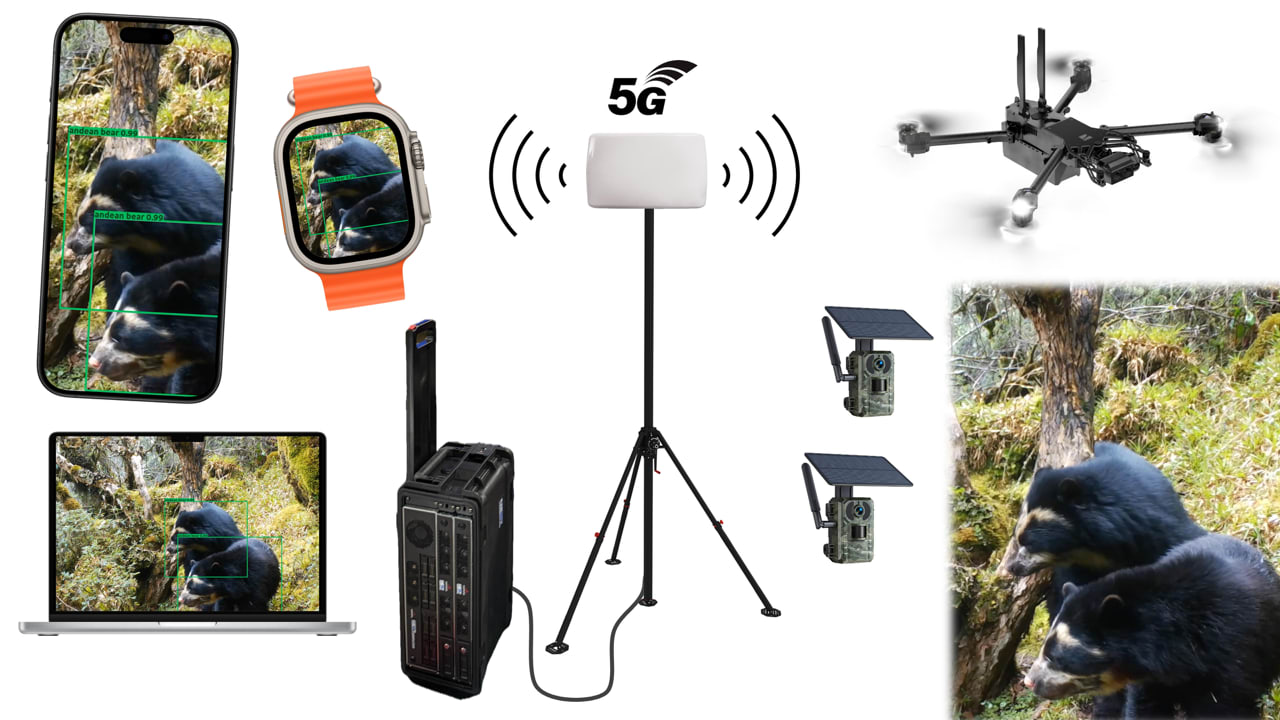
At the center is a portable 5G AI hotspot built on Ubuntu and Canonical Kubernetes, running on Arm-based Ampere servers. It connects drones, trail cameras, and researcher applications over a built-in private 5G network, with optional satellite backhaul.
Its purpose is to process wildlife data including photos and videos where it is collected, extract insights with AI, and share structured results globally.
Meet our team at Hall 2, stand 2D20
From edge intelligence to real-world impact
At the demo, visitors can explore wildlife video streams that are processed to identify animals, their species and even known individuals, shown on the geospatial TRAPPER interface with annotated media, plus a 5G dashboard showing user traffic on the active cells.
The AI 5G platform is completely open source, with the 5G base station software stack running OCUDU (developed by Software Radio Systems and DeepSig) and AI computer vision real-time and batch inference pipelines using YOLO, MegaDetector and SpeciesNet, the Open Science Conservation Fund developed TRAPPER conservation platform with BearID atop of Canonical Kubernetes on Ubuntu 24.04.3 arm64 LTS.
AI models execute directly on the AI 5G fly-away kit. Video is filtered and annotated locally. Selected metadata, processed video, and raw video is then shared with global biodiversity platforms such as the Global Biodiversity Information Facility.
This is technology applied to a tangible societal challenge. Wildlife conservation teams face pressure from habitat loss, poaching, and climate change. Scalable data collection and analysis improve species monitoring, inform policy decisions, and support collaboration across research institutions. The same open source building blocks used in telecom networks and enterprise data centers can help protect biodiversity.
The architecture can also apply to other use cases, such as industrial sites, utilities, ports, and other edge locations where private 5G and AI must operate together on constrained infrastructure.
An edge data center in a carry-on
The solution shown is powered by the NextComputing NextServer AI 5G fly-away kit, which is a self-contained airline carry-on AI 5G base station for field deployment.
The NextServer AI 5G fly-away kit includes:
- 2U AmpereOne 192 core Arm-based server with up to 1TB DDR5 and 1PB NVMe running AI compute workloads and 5G AI-RAN
- NVIDIA RTX 4000 SFF Ada GPU to drive 4x 4K displays and accelerated workloads
- 5G radio unit (RU) with external antenna(s) for up to 4 cells and 5,000 users
- High-speed networking for radio units and internet backhaul connectivity with Starlink Mini
This design brings together telecom-grade compute and AI acceleration in a portable form factor. A high core count enables parallel AI inference and 5G workloads on the same system. Arm-based efficiency reduces power and cooling demands, which is critical in remote environments.
For conservation teams operating in forests, savannahs, or mountainous regions, portability and power efficiency matter as much as raw performance. The fly-away kit reflects those constraints. It can be transported, deployed, and operated close to the data source without relying on fixed infrastructure.
For telco engineers, it also demonstrates how cloud-native 5G and AI workloads can share a common hardware platform at the edge.
Join us at MWC
This demo brings together Canonical, Arm, Ampere, NextComputing, and Software Radio Systems around a practical edge-to-cloud AI 5G design for wildlife conservation in partnership with the Open Science Conservation Fund, the BearID project and Universidad San Francisco de Quito.
If you are evaluating private 5G, AI at the edge, or Arm-based infrastructure for telecom workloads, visit the Canonical booth at MWC Barcelona 2026.
You will see a complete system running live, from radio to inference to application, in a form factor designed for the field.